Key Insights
Plastic pipes of every size need a tested fire stopping system where they pass through a fire rated wall or floor, while copper and steel pipes are generally protected with a wrap or sealant. Collar selection then depends on pipe material, nominal size, outside diameter, the building element and the FRL required, all checked against Promat’s tested data.
Every service that passes through a fire rated wall or floor creates a potential path for fire, smoke and hot gases. Plastic pipes are the greatest risk, because they soften and burn away in a fire and leave an open hole through the building element. Selecting the correct fire collar for each pipe is essential to maintaining the fire resistance level (FRL) of that element and achieving compliance with the National Construction Code.
In short, any plastic pipe that passes through a fire rated wall or floor requires a tested fire stopping system, regardless of its diameter. Fire collars cover plastic pipes from 16 mm conduits through to stacks as large as 315 mm OD, with ratings of up to -/240/240 depending on the pipe material, collar and building element, while copper and steel pipes are generally protected with a wrap or sealant instead.
Progressive Materials stocks the full Promat fire collar range at our Wangara warehouse and works with Perth plumbers, passive fire contractors and specifiers to size collars against project pipe schedules. This guide sets out what size and type of pipe needs a fire collar, covering pipe materials, pipe sizes and the installation details that determine which collar is suitable. For background on how intumescent collars close off a penetration, see our article How Do Fire Collars Work.
What Types Of Pipes Need Fire Collars?
Pipe material is the primary factor. Fire collars are designed for pipes that soften, melt or burn away in a fire. Where a pipe is plastic, it should be treated as requiring a fire collar or another tested system unless the manufacturer’s test data confirms otherwise.
On commercial and multi-residential buildings, the plumbing pipes and services that typically require fire collars are:
- uPVC and PVC drainage, stormwater and vent stacks, the most common pipes requiring collars.
- HDPE and PE stacks and siphonic drainage.
- PP and PP-R pressure and acoustic drainage systems.
- PEX, PB and composite PEX/Al/PEX water lines.
- ABS pipework, typically found in older or specialist systems.
- Plastic electrical and data conduits, including those carrying fibre optic cables.
Insulated services also belong on this list. Lagged copper pipes and air conditioning pair coils carry combustible insulation that burns away in the same way as plastic pipes, so they require a system tested for that specific combination.
Do Copper And Steel Pipes Need Fire Collars?
Bare copper and steel pipes do not melt at the temperatures reached in a typical building fire, so the intumescent material in a collar has nothing to close around when exposed to heat. The risk with metal pipes is heat transfer. Copper conducts heat through the fire barrier, and combustible materials in contact with the pipe on the non-fire side can ignite even though the wall or floor itself remains intact.
For this reason, metal pipes are generally protected with a wrap, sleeve or fire rated sealant rather than a fire collar. On One the Esplanade in the Perth CBD, the copper pipes were treated with PROMASEAL SupaWrap to provide two-hour protection, while the uPVC and HDPE pipes in the same penetration were protected with PROMASEAL FCW wall collars, and PROMASEAL Bulkhead Batt acted as the main fire barrier for the multi-service penetration. This demonstrates that pipe material, rather than pipe size, determines the product required.

What Size Pipe Needs A Fire Collar?
The National Construction Code does not set a minimum pipe size below which a plastic penetration can be left unsealed. A 20 mm PEX line through a fire rated wall creates a smaller opening than a 150 mm stack, but it still becomes a path for flames, smoke and hot gases once the pipe begins to soften.
What changes with pipe size is the most suitable product. Very small services can in some cases be sealed with a tested intumescent sealant or a conduit collar, while large stacks require heavier collars fixed to the slab. The manufacturer’s fire test data for the specific pipe size, pipe material and building element determines the correct solution, and following it is essential to maintaining the fire resistance level and the integrity of the barrier. Our guide to understanding FRLs explains how these ratings are expressed.
Fire Collar Sizes By Pipe Size
Promat fire collars are supplied by nominal pipe size, which is the figure printed on the pipe and shown on the hydraulic drawings. The table below shows how the main Promat collar ranges align with standard uPVC drainage pipe sizes, using typical outside diameters:
| Nominal pipe size | Typical uPVC OD | Retrofit FC | Cast in | Wall FCW | Socket FCS |
|---|---|---|---|---|---|
| 40 mm | 43 mm | FC 40 | CIL 40 | FCW 40 | FCS 40 |
| 50 mm | 56 mm | FC 50 | CIL 50 | FCW 50 | FCS 50 |
| 65 mm | 69 mm | FC 65 | CIL 65 | FCW 65 | FCS 65 |
| 80 mm | 83 mm | FC 80 | CIL 80 | Not available | Not available |
| 100 mm | 110 mm | FC 100 | CIL 100 | FCW 100 | FCS 100 |
| 150 mm | 160 mm | FC 150 | CIH 150 | FCW 150 | Not available |
| 250 to 300 mm | Up to 315 mm | FC 250, FC 300 | Not available | Not available | Not available |
PROMASEAL socket collars (FCS) are designed for penetrations where a socket fitting sits at the slab or wall. In floors with HDPE pipe they are tested for up to 180 minutes, with the exception of the 100 mm size, which is tested for up to 240 minutes. For cast in applications, PROMASEAL CIL covers 40 to 100 mm pipes, while PROMASEAL CIH is available in CIH 65, CIH 100 and CIH 150 sizes. Both are rated up to -/240/240, with insulation criteria varying by pipe type and size.
Conduits from 16 to 32 mm are protected with the single-size PROMASEAL Conduit Collar. It suits PEX, uPVC, PB and PEX/Al/PEX conduits and cables, and has been tested for up to 240 minutes in plasterboard, Speedpanel, AAC and concrete walls, as well as concrete slabs.

For non-standard pipe sizes, PROMASTOP UniCollar is supplied in 2,250 mm lengths that separate into 15 mm modules. Rather than ordering a separate collar for each pipe size, installers can cut the length required, with one box producing approximately five 110 mm collars. This is particularly useful on projects with a wide mix of pipe diameters.
How To Measure A Pipe For A Fire Collar
Most sizing errors result from confusing nominal size with outside diameter. A 100 mm uPVC pipe measures approximately 110 mm across the outside, and a collar sized for a 100 mm nominal pipe will not close correctly around a larger pipe. Before ordering, confirm the following:
- Read the pipe markings. Nominal size and pipe material are printed along the length of the pipe.
- Measure the outside diameter. Measure the circumference with a tape and divide by 3.14.
- Check for fittings. Sockets and couplings are wider than the pipe itself. PROMASEAL socket collars have a larger opening to suit these fittings.
- Measure the annular gap around the pipe. Gap limits vary by collar and substrate. For PROMASEAL FC collars fixed to a slab soffit, Promat specifies backfilling annular gaps greater than 12 mm with PROMASEAL Mortar, while FCS socket collars require mortar above 8 mm. Confirm the limit in the installation guide for the collar being used.
Where pipe movement may crack the seal, Promat recommends sealing around the pipe with PROMASEAL-A Acrylic Sealant. This limits cold smoke leakage and is not required to achieve the fire rating itself.
Matching The Collar To The Wall Or Floor
Pipe size and pipe material are only part of the selection. The same 100 mm stack requires a different system depending on the building element it passes through.
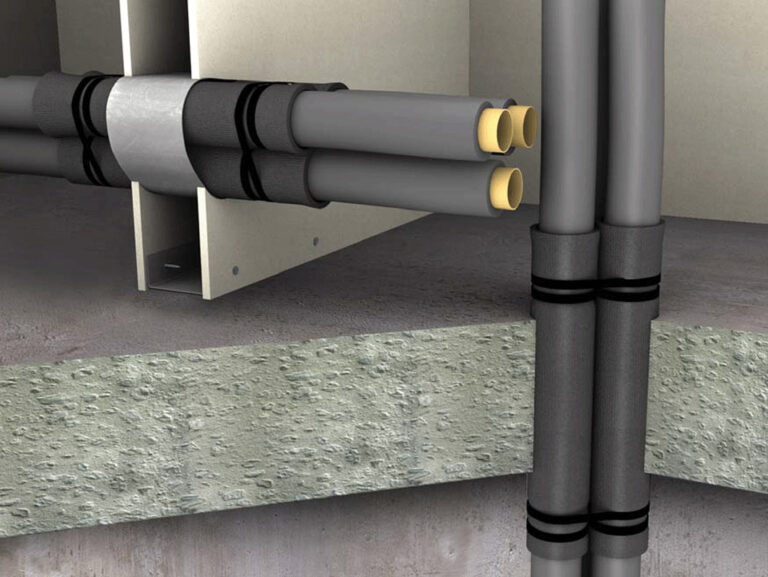
In concrete floor slabs, cast in collars are positioned on the formwork prior to the concrete pour and are generally the most cost effective option on new construction. PROMASEAL CIH is rated up to -/240/240 with plastic pipes such as uPVC and HDPE, and can accommodate uPVC pipe fittings within the collar itself. Where concrete slabs have already been poured, retrofit fire collars are fixed to the slab soffit with steel anchors and are also suitable for lined ceilings. Promat’s fixing guide specifies steel expanding anchors of at least 25 mm length for collars up to 100 mm, at least 35 mm for 150 mm collars, and 6.5 x 50 mm steel expanding anchors for 250 to 315 mm collars. Alloy and zinc alloy anchors are not suitable unless they have been fire tested.

Walls and other building elements have their own requirements. For retrofit FC collars, concrete and masonry walls at least 116 mm thick achieve up to -/120/120 with uPVC and HDPE pipes up to 110 mm OD. FC collars have also been tested in plasterboard walls from 90 mm thick, and lightweight framed walls require a collar on both faces. The PROMASEAL FCW wall collar takes a different approach, as it is inserted into the wall element rather than fixed to each face. It suits uPVC, HDPE and PP-R pipes and is rated up to -/120/120, so it should be checked against the FRL required. Cast in collars on profiled steel permanent formwork, such as Bondek or KingFlor, require specialist application methods and should be reviewed with our technical team before they are specified.
Choosing Fire Collars On Perth Projects
Most projects involve more than one pipe type. At the METRONET Byford and Armadale train stations, Progressive Materials supplied PROMASEAL Collars, PROMASEAL Bulkhead Batt and PROMASEAL SupaWrap to treat the high density of mechanical, electrical and data services across both sites, alongside the fire rated wall and floor/ceiling systems. The project demonstrates how mixed services require a coordinated, system-based approach to penetration sealing.
One the Esplanade followed the same approach. Our team prepared a fire management plan with the plumbing contractor that cross-referenced Promat approvals against every penetration type on site, as outlined in the One the Esplanade project overview. For any WA project, service penetrations should be scheduled by pipe material and pipe size early in the design stage, so that every collar installed matches a tested system and compliance is not left to the final inspection.
Frequently Asked Questions
The following questions are commonly raised when sizing fire collars against a pipe schedule.
What Kind Of Pipes Do Plumbers Use Now?
uPVC remains the standard for drainage and vent stacks, while PEX and composite pipes are widely used for water supply. HDPE and PP-R are common in high-rise stacks and acoustic drainage systems. All of these are plastic pipes, so all require a tested fire stopping system where they pass through a fire rated barrier.
Is There A Minimum Pipe Size For A Fire Collar?
No. The National Construction Code does not exempt small plastic pipes. Smaller services may suit a conduit collar or a tested intumescent sealant, but they still require a compliant system.
Can One Collar Protect Several Pipes?
In most cases, one collar is required per pipe. Some systems are tested for grouped pipe penetrations, such as the cast in PROMASEAL Services Collar or PROMASEAL Bulkhead Batt, but only within their tested limits.
How Do I Find The Right Collar For A Pipe?
Start with the pipe material, nominal size and outside diameter, then confirm the wall or floor type and the FRL required. Check these details against the manufacturer’s tested data, or send the pipe schedule to our technical team for review.
Getting The Right Collar For Every Pipe
Determining what size and type of pipe needs a fire collar follows a clear process. Plastic pipes of every size require protection, while metal pipes are generally treated with a wrap or sealant. From there, collar selection is determined by nominal size, outside diameter and the building element the pipe passes through.
The Progressive Materials technical team in Wangara can review your pipe schedule line by line, match each penetration to a tested Promat system and supply the fire collars from local stock. Browse the full range of Promat fire collars, call 08 9445 8300 or send through your pipe schedule and we will recommend a compliant collar for every penetration.

- What Size And Type Of Pipe Needs A Fire Collar? - 17 November 2026
- Solving Acoustic, Access and Maintenance Challenges with Metal Ceiling Systems - 14 April 2026
- Passive Fire Protection in Practice: Common On-Site Challenges and Solutions - 2 April 2026